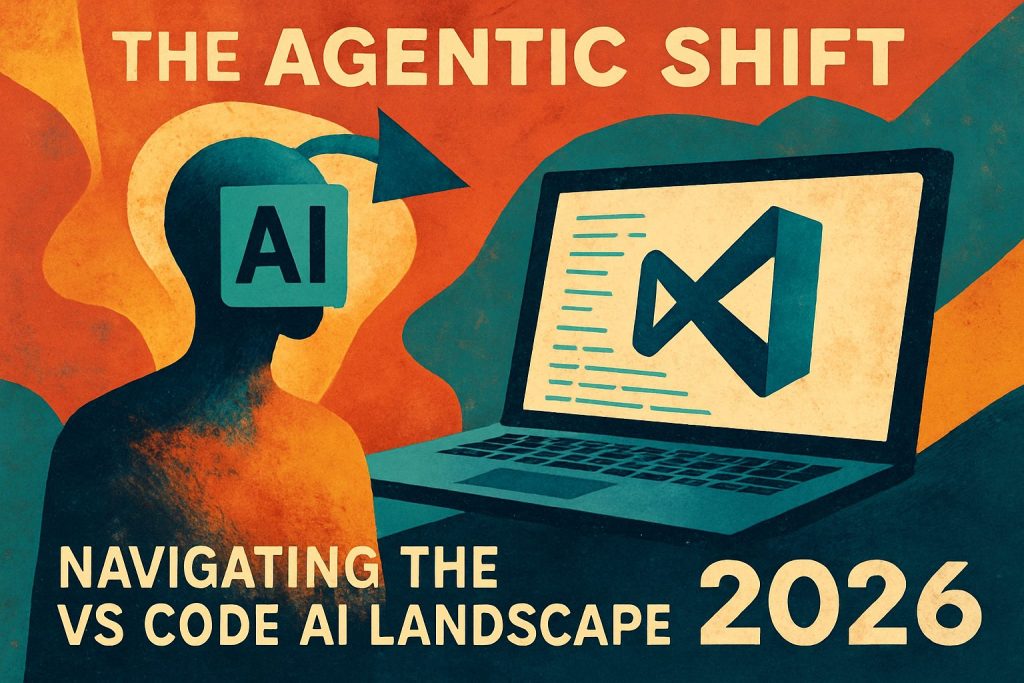
The Agentic Shift: Navigating the VS Code AI Landscape in 2026
The Rise of the Autonomous Agent
The defining characteristic of the 2026 VS Code ecosystem is the prevalence of agents that go beyond suggestions to perform actions. While GitHub Copilot remains the market leader with over 53.8 million installs, it ranks lower in “agentic-specific” searches due to marketing terminology rather than a lack of capability. In contrast, tools explicitly branded as “agents,” such as Cline, have surged in popularity, with Cline alone reaching over 1.9 million installs and positioning itself as the leading open-source AI agent. Cline distinguishes itself with a “Plan-and-Act” architecture, native Model Context Protocol (MCP) support for custom tool integration, and the ability to run commands and edit files autonomously.
This agentic shift is not limited to extensions. Standalone editors built on VS Code’s foundation, such as Cursor and Windsurf, have emerged as formidable competitors. Cursor, for instance, utilizes a proprietary “Composer 2” model to coordinate sub-agent work, routing tasks through premium models only when necessary for cost efficiency. Windsurf, powered by Codeium, features a “Cascade” agent for autonomous workflows and has been noted for taking the industry by storm in late 2025. These standalone editors offer a more integrated experience than extensions, often providing real-time collaboration and polished autocomplete that rivals or exceeds the native VS Code experience.
The Extension vs. Editor Debate
A critical strategic decision for teams is whether to adopt an extension or migrate to a standalone editor. Extensions like Cline, Continue, and Qodo Gen run within the existing VS Code environment, preserving the user’s configuration and workflow. Cline, for example, supports Bring Your Own Key (BYOK) for model flexibility and allows users to select from over 300 models, making it a favorite for those seeking vendor independence. Continue, another open-source leader with approximately 2.5–2.8 million installs, focuses on “config-as-code” and zero-data-leakage local deployment, making it the preferred choice for enterprises requiring strict privacy.
In contrast, Cursor and Windsurf are VS Code forks that require a migration of the entire development environment. While Cursor offers excellent context control and multi-file refactoring capabilities, it lacks native VS Code integration, meaning teams must import all extensions and themes. This migration can take up to 30 seconds per user and requires careful planning for managed enterprise environments. However, the trade-off is often a more cohesive AI-native experience. Cursor’s “Composer” mode allows for multi-file changes that feel telepathic, while Windsurf offers “Cascade” for autonomous workflows that extensions often struggle to match.
Pricing Models and Hidden Costs
The pricing landscape in 2026 reveals a stark divide between subscription-based models and BYOK (Bring Your Own Key) flexibility. GitHub Copilot Business costs $19 per user per month, while Enterprise is $21 per user per month. Cursor Pro is priced at $20 per user per month, with Business at $40 per user per month. Tabnine Enterprise is the most expensive option, ranging from $39 to $59 per user per month, often requiring annual commitments.
However, the “Free” label for open-source tools like Cline and Continue can be misleading. While the extensions themselves are free, they rely on external LLM APIs, creating a “free tool, expensive usage” dynamic. Heavy users of Cline can face monthly costs of $50 to $200 depending on their token consumption. This unpredictability contrasts with the fixed costs of Cursor or Copilot, where usage is often capped or billed as part of a subscription. For a 500-developer team, the cost difference is significant: GitHub Copilot Business costs approximately $114,000 annually, while Cursor Business costs $192,000 annually. Many organizations negotiate 20-40% discounts through volume deals, but the base pricing remains a key differentiator.
Local Deployment and Privacy
A growing trend in 2026 is the integration of local AI models, driven by the need for privacy and cost control. Ollama has emerged as the primary runtime for running open-source models locally, with major models like Qwen 2.5, Llama 3.1, and DeepSeek Coder supported for agentic workflows. GitHub Copilot has integrated direct support for local Ollama models, allowing developers to run agentic workflows within the IDE without external transmission. This “air-gapped” development is crucial for defense and enterprise sectors where code must not leave the premises.
Continue excels in this area, offering a fully supported stack for local AI coding that ensures zero latency and complete privacy. Tabnine also offers on-premises deployment options for enterprises with strict security requirements. The trade-off is hardware: running models like DeepSeek Coder V2 requires significant resources (140GB unified memory), making lighter alternatives like Qwen 2.5 (4.7GB) more practical for standard workstations. This local-first approach shifts the expense from API tokens to hardware and electricity, making it a viable alternative for high-volume usage where cloud costs would be prohibitive.
The Strategic Conclusion
The research indicates that the most effective implementations layer multiple tools rather than relying on a single platform. Developers increasingly use 2-3 different AI tools simultaneously: Copilot or Cursor for coding, Claude or Gemini for reasoning, and Rovo Dev for enterprise workflows. The 2025 Stack Overflow Developer Survey indicates that 84% of developers use or plan to use AI tools, suggesting that the “best” tool is often the one that fits the specific task at hand.
For individual developers, Cline offers the best balance of flexibility and cost, allowing them to choose their own models and pay only for what they use. For teams prioritizing ease of use and integration, Cursor provides the most mature ecosystem, despite the migration cost. For enterprises requiring strict compliance and security, Tabnine or GitHub Copilot Enterprise offer the necessary governance, though at a higher price point. The future of VS Code AI is not about a single winner, but about a layered ecosystem where agents, extensions, and standalone editors coexist to maximize productivity.